Executive Summary
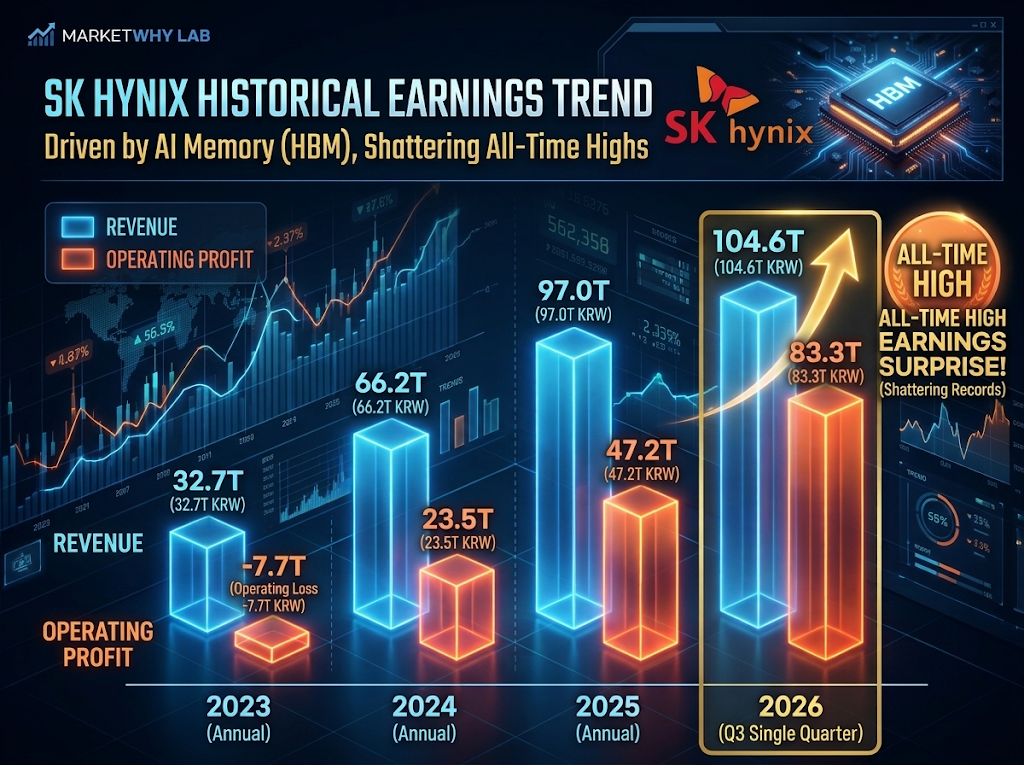
SK Hynix reported record-breaking third-quarter results, with both revenue and operating profit reaching all-time highs.
The company also announced a major shareholder return plan, reinforcing expectations that SK Hynix is evolving from a pure AI memory growth story into a combination of growth, cash generation, and shareholder returns.
Immediately after the earnings release, the stock initially lost momentum as investors took profits in a classic sell-on-news reaction.
However, the market changed direction once foreign investors began buying aggressively.
SK Hynix eventually closed 10.89% higher, Samsung Electronics gained 9.01%, and the KOSPI surged 6.63% to close at 6,012.44.
The next major event is Samsung Electronics’ detailed earnings announcement on October 29.
Expectations for strong earnings are already high, but after two consecutive days of sharp gains in Korean semiconductor stocks, the risk of another sell-on-news reaction should not be ignored.
For MARKETWHY LAB, the most important signal tomorrow will not be the headline earnings number itself, but whether foreign investors continue to absorb profit-taking supply.
1. SK Hynix Delivers Another Record Quarter
SK Hynix reported its third-quarter 2026 earnings on October 28.
The key figures were:
- Revenue: KRW 104.6 trillion
- Operating profit: KRW 83.3 trillion
- Net income: KRW 39.8 trillion
- Operating margin: 80%
Both revenue and operating profit reached record quarterly highs.
Compared with the previous quarter, revenue increased by approximately 32%, while operating profit rose by about 38%.
The company said strong sales of high-value products such as HBM4 and server DDR5 drove the results.
SK Hynix also expects HBM4 to become one of its key products beginning in the fourth quarter.
This was not simply another strong earnings report.
It was also a direct response to concerns that the AI memory cycle may be approaching a peak.
2. Shareholder Returns Were Just as Important as Earnings
The shareholder return announcement was equally significant.
SK Hynix said it plans approximately KRW 100 trillion in shareholder returns for 2026.
The package includes:
- More than KRW 30 trillion in cash dividends
- More than KRW 60 trillion in share buybacks and cancellations
- Including the previously announced KRW 40 trillion share repurchase program
The company also announced a third-quarter dividend of KRW 20,000 per share.
This consists of:
- KRW 10,000 linked to earnings performance
- KRW 10,000 as a special dividend related to investment gains from Kioxia
While the structure differed from earlier market speculation of a KRW 23,000 special dividend, the announcement confirmed that SK Hynix intends to return a significant portion of its investment gains to shareholders.
The company also indicated that share repurchases could continue on a quarterly basis.
This is important because the investment case for SK Hynix is gradually changing.
The company is no longer viewed only as an HBM growth stock.
It is increasingly becoming a combination of:
AI growth + strong free cash flow + aggressive shareholder returns.
3. Why Did Sell-on-News Pressure Appear in the Morning?
Despite record earnings and a strong shareholder return plan, SK Hynix initially lost momentum after the earnings announcement.
This was not unexpected.
The stock had already risen strongly before the earnings release, and investors had already priced in expectations for:
- Record earnings
- Special dividends
- Share buybacks
- Continued AI memory demand
When expectations are already high, even very strong results can trigger profit-taking.
This is a classic sell-on-news setup.
But the most important part of today’s session was what happened next.
4. Foreign Investors Changed the Direction of the Market
The key development today was the shift in foreign investor flows.
Foreign investors bought approximately:
- KRW 385.9 billion of SK Hynix
- KRW 374.8 billion of Samsung Electronics
That means foreign investors purchased roughly KRW 760 billion combined in Korea’s two largest semiconductor stocks.
This was particularly significant because foreign investors had been major sellers of Korean semiconductor stocks over the previous several weeks.
SK Hynix had experienced prolonged foreign selling pressure, making today’s strong reversal an important signal.
MARKETWHY LAB has repeatedly emphasized one key point:
The market reaction after good news matters more than the good news itself.
Today, foreign investors provided the answer.
They bought the news.
5. Foreign Buying Overwhelmed the Sell-on-News Pressure
SK Hynix eventually closed at KRW 1,487,000, up 10.89%.
Samsung Electronics gained 9.01% to close at KRW 242,000.
The KOSPI surged 6.63% and finished at 6,012.44.
Market-wide flows also showed a clear pattern.
Foreign investors and institutions were net buyers, while retail investors sold into the rally.
This means the rally was not simply driven by speculative retail buying.
Instead, institutional and foreign capital absorbed the selling pressure.
That makes today’s move more meaningful.
6. But One Day of Foreign Buying Is Not Enough
Today’s foreign buying was clearly positive.
However, MARKETWHY LAB does not believe that one strong session is enough to declare that the foreign selling trend has completely ended.
The key word is continuity.
The next stage should ideally look like this:
Continued foreign buying
→ Higher price lows
→ Stable trading volume
→ Multiple consecutive sessions of net foreign inflows
Today may represent the beginning of a change in trend.
But it does not yet confirm that the longer-term trend has fully reversed.
7. Now the Focus Shifts to Samsung Electronics
The next major event is Samsung Electronics’ third-quarter earnings conference call on October 29.
However, unlike SK Hynix, Samsung has already released preliminary third-quarter results.
The preliminary figures were:
- Revenue: KRW 195 trillion
- Operating profit: KRW 107.4 trillion
These numbers were already released earlier this month.
Therefore, tomorrow’s headline earnings figures will not be completely new information for the market.
The more important issue will be the details behind the numbers.
8. What Matters More Than Samsung’s Headline Earnings
Tomorrow, investors should pay attention to several key areas.
① Semiconductor Division Profitability
Investors need to understand how much Samsung’s semiconductor business contributed to overall earnings.
The key question is whether higher memory prices are translating into stronger margins.
② HBM Competitiveness
HBM remains one of the most important investment themes for Samsung Electronics.
Investors will focus on:
- Progress in HBM customer qualification
- Shipment expansion
- Competitive positioning versus SK Hynix
- HBM4 production and customer adoption
The market wants evidence that Samsung is closing the gap in the AI memory market.
③ 2027 Memory Market Outlook
The market is already looking beyond 2026.
Investors will closely monitor comments related to:
- DRAM pricing
- HBM demand
- AI server investment
- Capital expenditure
- Memory supply tightness
- 2027 demand visibility
Forward guidance may matter more than the reported quarterly results.
9. The Biggest Risk: Stocks Have Already Rallied Sharply
This is the most important factor heading into tomorrow.
Samsung Electronics rose sharply yesterday and gained another 9.01% today.
SK Hynix also rose strongly yesterday before jumping another 10.89% today.
In other words, Korea’s two largest semiconductor stocks have rallied aggressively for two consecutive sessions.
That means the market is entering Samsung’s earnings announcement from an elevated price level.
At this point, even strong earnings may not be enough to trigger another immediate rally.
Samsung’s headline earnings are already known.
Therefore, investors may decide to take profits after the detailed results are released.
This creates a meaningful sell-on-news risk.
10. But Today’s SK Hynix Move Offers an Important Lesson
It would also be a mistake to assume that Samsung Electronics must fall tomorrow.
SK Hynix demonstrated today that sell-on-news selling can be overwhelmed if strong institutional and foreign demand appears.
The critical question tomorrow is not:
Will profit-taking appear?
Profit-taking is likely.
The more important question is:
Who will absorb the selling pressure?
If foreign investors continue to buy aggressively, the market may remain strong despite early profit-taking.
11. Three Things MARKETWHY LAB Will Watch Tomorrow
① Foreign Investor Flows in Samsung Electronics
Foreign investors bought aggressively today.
If they continue to accumulate Samsung Electronics tomorrow, it would strengthen the case that foreign capital is returning to Korean semiconductors.
If foreign investors instead turn into heavy sellers after the earnings release, caution would be warranted.
② Whether the Morning High Can Hold
A typical sell-on-news pattern often looks like this:
Strong opening → early high → continued selling → weak close
If Samsung Electronics rises sharply after the earnings call but gives back most of the gains, that would signal meaningful profit-taking pressure.
However, if the stock sells off early and then recovers while forming higher intraday lows, it would suggest that buyers remain active.
③ Whether SK Hynix Moves in the Same Direction
Samsung should not be analyzed in isolation.
Korean semiconductor sentiment is currently being driven by both Samsung Electronics and SK Hynix.
If Samsung’s earnings trigger renewed foreign selling in both companies, it could signal broader sector profit-taking.
If foreign buying continues in both names, the possibility of a more structural shift in semiconductor flows would increase.
12. Two Scenarios for Tomorrow
Scenario A — Sell on News
Samsung reports results in line with expectations.
The earnings conference call provides no major positive surprise.
After two days of strong gains, investors begin taking profits.
Foreign investors turn into net sellers.
In this scenario, a short-term correction would be completely normal.
There would be little reason to chase the stock during the morning session.
Scenario B — Foreign Investors Absorb the Selling Again
Samsung initially faces profit-taking pressure.
However, foreign investors continue to buy.
Samsung and SK Hynix both hold their intraday lows and recover.
In this scenario, the current semiconductor rebound may be more than a short-term technical rally.
It could indicate a broader return of foreign capital to Korean semiconductor stocks.
MARKETWHY LAB Conclusion
The most important part of today’s SK Hynix session was not simply the record earnings.
The real signal was what happened after the earnings release.
Sell-on-news pressure appeared.
Then foreign investors stepped in.
That buying changed the direction of the stock and ultimately helped drive a powerful rally across the Korean market.
SK Hynix gained 10.89%.
Samsung Electronics rose 9.01%.
The KOSPI surged 6.63%.
Foreign investors purchased roughly KRW 760 billion combined in Samsung Electronics and SK Hynix.
This was clearly a meaningful change from the foreign selling pressure that had dominated the market in recent weeks.
However, the next challenge is price.
Both Samsung Electronics and SK Hynix have now rallied sharply for two consecutive sessions.
Samsung’s headline earnings figures are also already known.
That makes tomorrow a natural setup for sell-on-news profit-taking.
But sell-on-news itself is not necessarily bearish.
The key question is:
Will foreign investors absorb the selling once again?
MARKETWHY LAB prefers to avoid predicting the opening direction.
Instead, tomorrow we will focus on the sequence:
Samsung earnings → profit-taking → foreign investor flows → closing price
Today’s SK Hynix move delivered another important reminder:
Earnings create the narrative, but short-term price direction is ultimately determined by capital flows.
Data Reference: October 28, 2026
This content is provided for informational and educational purposes only and is based on publicly available corporate disclosures and market data. It does not constitute investment advice or a recommendation to buy or sell any security. All investment decisions and their consequences remain the responsibility of the individual investor.