October 29, 2026 | Author: BS
Executive Summary
Following SK Hynix’s record-breaking earnings, Samsung Electronics also reported its strongest quarterly results ever.
However, the market reacted not to the strength of the earnings, but to elevated expectations and profit-taking pressure.
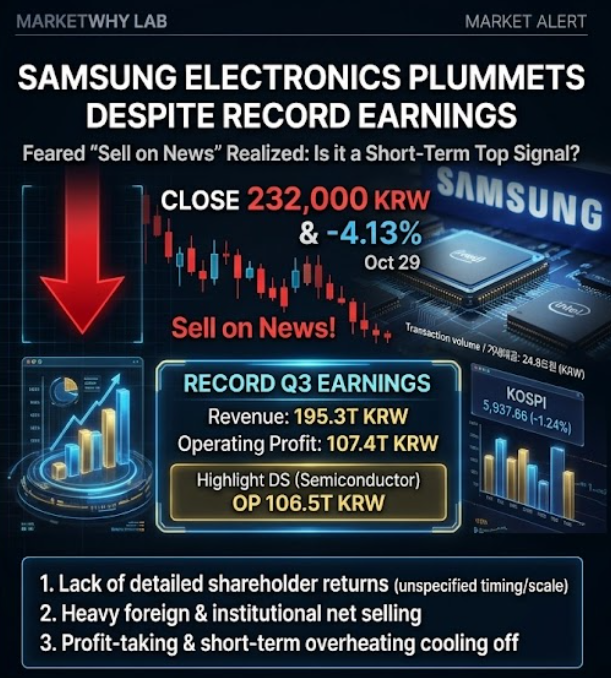
Samsung Electronics initially traded higher, but after the detailed earnings and shareholder return plans were released, the stock reversed sharply and fell more than 6% intraday before closing 4.13% lower at KRW 232,000.
Foreign investors and institutions turned into net sellers in the KOSPI, while program trading also showed a clear sell imbalance.
MARKETWHY LAB views today’s move as a combination of classic sell-on-news pressure and short-term overbought conditions.
This does not necessarily mean the long-term semiconductor uptrend is over. However, after two consecutive days of sharp gains, the possibility of a short-term market top has clearly increased.
The next key signal will be whether foreign investors continue selling or begin accumulating again after the correction.
1. Samsung Electronics Also Posts Record Quarterly Earnings
Samsung Electronics reported its third-quarter 2026 results on October 29.
The key figures were:
- Revenue: KRW 195.3 trillion
- Operating profit: KRW 107.4 trillion
Both figures represented extremely strong results.
Operating profit exceeded KRW 100 trillion for the first time, making this one of the strongest quarters ever reported by a global technology company.
The semiconductor DS division alone generated approximately:
- Revenue: KRW 147.1 trillion
- Operating profit: KRW 106.5 trillion
Memory profitability remained exceptionally strong, supported by higher DRAM prices, server demand, and growing HBM shipments.
On fundamentals alone, the results were clearly bullish.
But the market had already expected strong numbers.
That became the problem.
2. Strong Earnings Were Already Priced In
Samsung Electronics had already rallied sharply before the earnings release.
The previous day, SK Hynix surged more than 10% after record earnings, while Samsung Electronics also gained more than 9%.
The market had already been pricing in:
- A strong memory cycle
- HBM growth
- Record earnings
- Strong cash generation
- Additional shareholder returns
When expectations are already extremely high, good earnings are no longer enough.
The market needs something better than expected to justify another leg higher.
Today, that additional surprise did not arrive.
3. From Early Gains to a 6% Intraday Drop
Samsung Electronics initially traded higher after the open.
At one point, the stock reached approximately KRW 249,000, up nearly 3%.
But after the detailed earnings presentation and shareholder return plan were released, the direction changed quickly.
Selling intensified.
The stock dropped more than 6% intraday and eventually closed at:
KRW 232,000
-4.13%
This is a textbook example of sell on the news.
Investors bought ahead of strong earnings.
Once those earnings were officially confirmed, many used the event as an opportunity to take profits.
4. The Market Wanted More Specific Shareholder Returns
Samsung’s shareholder return program itself was not weak in absolute terms.
The company announced a third-quarter cash dividend of:
KRW 4,601 per share
with total cash dividends of approximately:
KRW 30 trillion
Samsung also expects its total 2026 shareholder return to reach roughly KRW 90–110 trillion.
After accounting for previously executed and confirmed distributions, approximately KRW 55–75 trillion remains available for further shareholder returns.
This could include additional dividends and large-scale share buybacks and cancellations.
The problem was not the size.
The problem was specificity and timing.
Investors wanted clearer answers on:
- How much would be used for share buybacks?
- How much would be canceled?
- When would the remaining capital be deployed?
- Would Samsung announce an immediate additional return package?
Instead, Samsung said the final size and structure would be decided by the board around the end of January 2027.
That left the market with fewer immediate catalysts than expected.
So the correct interpretation is not:
“Samsung announced weak shareholder returns.”
It is more accurate to say:
“Samsung’s shareholder return plan lacked the level of immediate detail that the market had already priced in.”
5. The Contrast with SK Hynix Became More Visible
The difference between Samsung Electronics and SK Hynix became especially important today.
SK Hynix had announced:
- Record earnings
- Large cash dividends
- Share buybacks
- Share cancellations
- A clearer shareholder return roadmap
Its capital return policy was more direct and easier for investors to price.
Samsung, by comparison, left several major decisions for January 2027.
As a result, even while Samsung Electronics declined sharply, SK Hynix remained relatively strong.
This shows how much the Korean market currently values capital allocation clarity.
Strong earnings alone are no longer enough.
Investors increasingly want to know:
“What will management do with the cash?”
6. Foreign Investors Turned Sellers Again
For MARKETWHY LAB, today’s most important signal was once again foreign investor flow.
In the broader KOSPI market:
- Foreign investors were net sellers
- Institutions were also net sellers
- Retail investors were net buyers
Program trading also showed a clear sell imbalance.
Samsung Electronics itself experienced meaningful foreign selling.
This was a reversal from the previous session, when foreign investors aggressively bought both Samsung Electronics and SK Hynix and helped drive the semiconductor rally.
That change matters.
Yesterday, foreign inflows pushed the market higher.
Today, foreign outflows contributed to the reversal.
This is exactly why capital flows remain one of the most important short-term indicators.
7. KOSPI Falls Back Below 6,000
The broader Korean market also reversed sharply.
The KOSPI traded above 6,100 during the session, but after Samsung’s earnings event, the index weakened significantly.
It eventually closed below 6,000 again.
This followed an exceptionally strong rally the previous day.
Therefore, today’s correction itself should not automatically be interpreted as abnormal.
The market had risen too quickly.
A major earnings event simply became the trigger for short-term profit-taking.
8. MARKETWHY LAB View: Short-Term Top Risk Has Increased
MARKETWHY LAB believes the probability of a short-term top has increased.
There are three main reasons.
① The Rally Was Too Fast
Samsung Electronics and SK Hynix had both risen sharply over just two sessions.
The faster prices rise, the greater the incentive for existing holders to lock in profits.
At the same time, new buyers become less willing to chase at elevated prices.
② Record Earnings Failed to Produce Another Rally
Samsung delivered record earnings.
Yet the stock fell sharply.
That tells us something important.
The market had already priced in much of the good news.
When record earnings fail to push a stock higher, expectations may have become too stretched.
③ Foreign and Program Selling Appeared Together
This is the most important point.
At an elevated price level, the market saw:
Foreign selling
Institutional selling
Program selling
at the same time.
That is not an ideal setup for chasing the market higher.
9. But This Does Not Mean the Long-Term Uptrend Is Over
A short-term top and the end of a long-term semiconductor cycle are not the same thing.
Samsung Electronics and SK Hynix still have very strong fundamentals.
Samsung’s semiconductor business remains highly profitable.
AI, server memory, HBM, and advanced DRAM demand remain structural growth drivers.
SK Hynix continues to benefit from strong HBM demand and high-margin server memory products.
Therefore, today’s selloff should not immediately be interpreted as:
“The semiconductor cycle is over.”
A more reasonable interpretation is:
Fundamentals remain strong, but prices moved too far too quickly.
10. The Market Now Needs to Prove Where Support Exists
Until yesterday, the key question was:
“Will foreign investors come back?”
Starting today, the question changes.
Now we need to ask:
“At what price will foreign investors start buying again?”
That is the next important signal.
Investors should watch:
- Whether foreign selling begins to slow
- Whether Samsung forms a stable short-term low
- Whether trading volume decreases during the correction
- Whether SK Hynix also turns into a foreign-selling target
- Whether foreign flows return after the market cools
There is little reason to predict the exact bottom immediately after a sharp reversal.
The more useful approach is to wait for evidence that the selling pressure is weakening.
11. What Would Confirm a Better Entry Setup?
MARKETWHY LAB will focus on three signals.
① Foreign Selling Slows
One day of foreign selling is not enough to confirm a larger trend.
What matters is whether the selling accelerates or gradually weakens.
A clear reduction in foreign selling would be the first positive signal.
② Price Begins to Stabilize
After a sharp drop, the stock needs to establish support.
A stronger structure would be:
Initial low → rebound → retest → previous low holds
That is more meaningful than a simple one-day bounce.
③ Foreign Investors Turn Back to Net Buying
This would be the strongest signal.
If Samsung Electronics and SK Hynix stabilize and foreign investors return as consistent net buyers, today’s decline could eventually be viewed as a short-term correction within a broader uptrend.
MARKETWHY LAB Conclusion
Samsung Electronics delivered record-breaking earnings.
Revenue reached approximately KRW 195.3 trillion.
Operating profit reached approximately KRW 107.4 trillion.
Yet the stock fell.
That is the key message from today’s market.
Samsung initially traded higher, but after the detailed earnings and shareholder return announcements, the stock reversed and fell more than 6% intraday before closing 4.13% lower.
The problem was not weak earnings.
The problem was expectations.
Investors had already priced in record profits.
They also wanted more immediate and specific shareholder return measures.
When the announcement did not exceed those expectations, profit-taking accelerated.
Foreign investors, institutions, and program trading all contributed to the selling pressure.
For this reason, MARKETWHY LAB believes the probability of a short-term top has increased.
However, this should not be confused with the end of the long-term semiconductor cycle.
The underlying earnings environment remains strong.
The more important question now is:
Where will foreign investors begin buying again?
Yesterday, foreign buying drove the rally.
Today, foreign selling drove the decline.
The lesson remains the same.
Earnings determine corporate value.
But in the short term, capital flows determine price direction.
Data Reference: October 29, 2026
This content is provided for informational and educational purposes only and is based on publicly available corporate disclosures and market data. The discussion of a possible short-term market top represents a market scenario, not a prediction or guarantee of future price action. This content does not constitute investment advice or a recommendation to buy or sell any security.