South Korea’s stock market suffered another sharp decline just one day after its rebound.
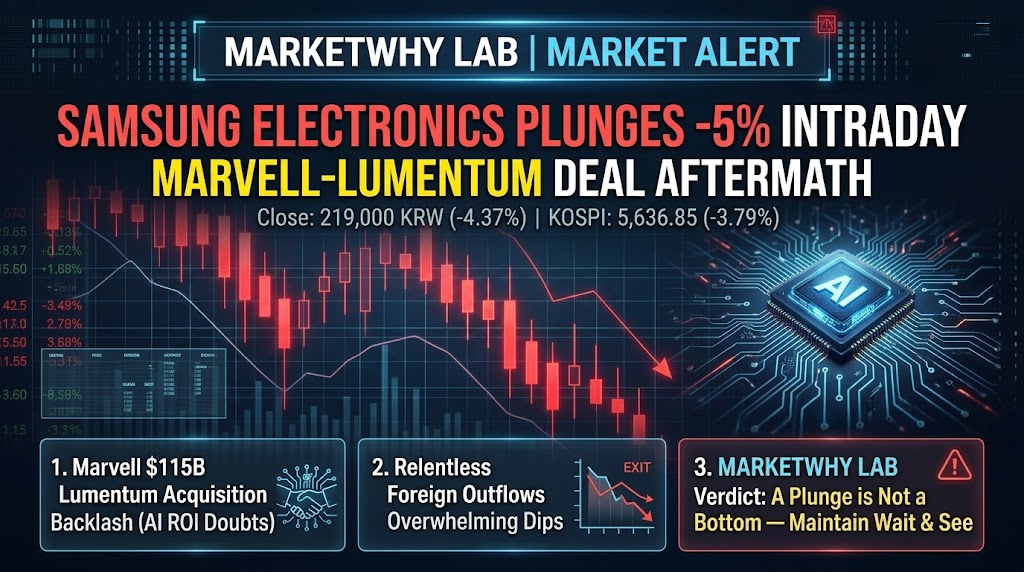
Samsung Electronics fell as much as 5% intraday before attempting a recovery, but continued selling pressure pushed the stock lower again.
SK Hynix also dropped sharply, while the KOSPI experienced another significant decline.
Persistent foreign investor selling, weakness in U.S. AI and semiconductor stocks, and uncertainty ahead of the U.S. midterm elections combined to pressure the Korean market.
The market instability that MARKETWHY LAB previously highlighted has once again become a major concern.
1. Samsung Electronics Falls Again: Foreign Selling Limits the Recovery
Samsung Electronics came under significant selling pressure today, falling approximately 5% at its intraday low.
Although bargain hunters attempted to support the stock, the recovery failed to gain momentum.
Samsung Electronics: KRW 219,000 (-4.37%)
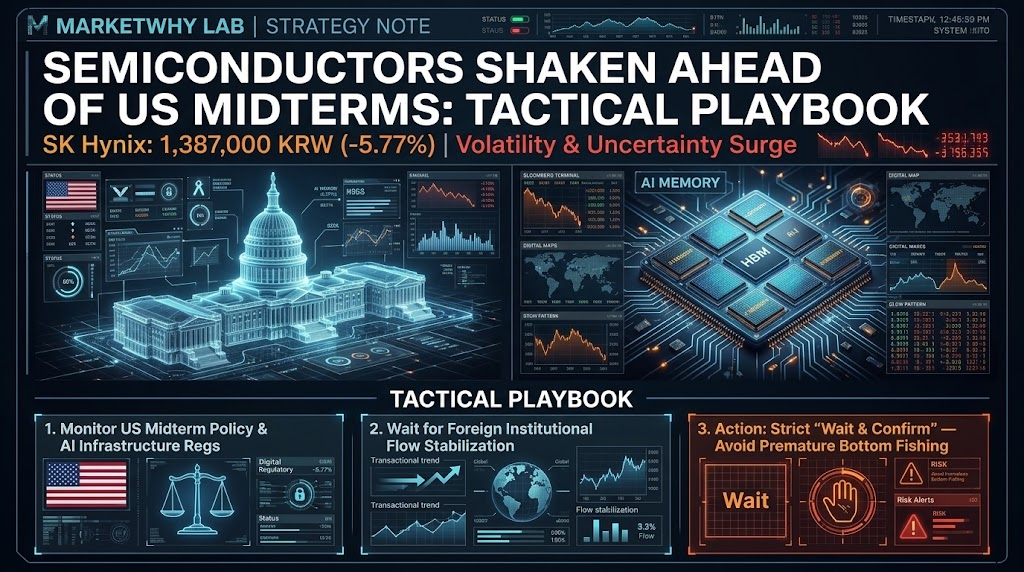
SK Hynix: KRW 1,387,000 (-5.77%)
KOSPI: 5,636.85 (-3.79%)
The most concerning development was that selling pressure returned whenever the stocks attempted to rebound.
As long as foreign investors continue reducing their positions, buying from domestic institutions and retail investors alone may not be sufficient to establish a sustainable upward trend.
The key question is no longer how much the stocks have fallen, but whether foreign investors are finally ready to stop selling.
2. A New U.S. Market Variable: Marvell’s Acquisition of Lumentum
One major development attracting attention in the U.S. technology sector is Marvell Technology’s acquisition of Lumentum, a company specializing in optical communications technology.
Marvell agreed to acquire Lumentum in a deal valued at approximately $11.5 billion.
The strategic objective is to strengthen its position in optical connectivity, a critical technology for next-generation AI data centers.
AI data centers require enormous amounts of data to move between GPUs, processors, and networking systems.
As traditional copper-based connections face limitations, optical communication technology is becoming increasingly important.
However, the market reaction was not entirely positive.
Marvell shares: Fell more than 10% on the announcement day.
Lumentum shares: Fell more than 15%.
Investors focused more on the acquisition price, integration risks, and financing burden than on the potential long-term benefits.
The broader message is important:
Investing heavily in AI infrastructure does not automatically translate into higher stock prices.
3. AI Investment Continues, but Markets Are Demanding Profitability
The recent weakness should not be attributed solely to the Marvell-Lumentum transaction.
Concerns about the financial burden of AI infrastructure investment have been growing across U.S. technology markets.
Oracle’s reported plan to raise approximately $20 billion through equity and debt financing for its AI infrastructure expansion has also raised questions about funding costs and future investment returns.
Major semiconductor stocks, including AMD, Intel, and Micron, have also experienced selling pressure.
The market’s priorities are changing.
Previously, investors focused on how much companies were investing in AI.
Now, they increasingly want to know:
How much actual profit will those investments generate?
This shift in investor expectations is creating additional pressure on South Korean semiconductor companies.
4. U.S. Midterm Elections Add Another Layer of Uncertainty
Another important factor is the upcoming U.S. midterm elections.
The election results could influence expectations surrounding fiscal policy, taxation, trade policy, and technology-sector regulation.
In particular, policies related to electricity supply, data center construction, and AI infrastructure investment could affect the long-term investment strategies of major technology companies.
Election results will not immediately change semiconductor earnings.
However, when global technology stocks are already under pressure, political uncertainty can further weaken investor confidence.
MARKETWHY LAB Trading Strategy
At this stage, the most important factor is not simply the percentage decline in stock prices.
The key indicators are whether foreign investors return and whether U.S. technology stocks stabilize.
MARKETWHY LAB’s strategy is as follows:
① Avoid Chasing a Rebound
A sharp decline does not automatically mean a stock has reached its bottom.
Rather than buying simply because prices have fallen significantly, investors should wait for selling pressure to stabilize.
② Monitor Foreign Investor Flows
Buying from institutions and retail investors alone is not enough.
A meaningful reduction in foreign selling, followed by a shift toward net buying, would provide a stronger signal of recovery.
③ Wait for Direction After the U.S. Midterm Elections
We prefer to assess the election results and the subsequent reaction in U.S. technology stocks before making aggressive decisions in Korean semiconductor stocks.
MARKETWHY LAB Conclusion
The market instability we previously highlighted has once again become a reality.
Samsung Electronics plunged approximately 5% intraday and struggled to maintain its attempted recovery.
In the United States, the Marvell-Lumentum acquisition has brought renewed attention to acquisition costs and the profitability of AI infrastructure investments.
At the same time, uncertainty surrounding the U.S. midterm elections is adding another layer of risk.
The important distinction is between the long-term growth potential of the semiconductor industry and short-term stock market movements.
There is no reason to conclude that AI industry growth is over.
However, investors are becoming more demanding. They are looking beyond investment announcements and focusing increasingly on actual profitability, financing costs, and returns on capital.
MARKETWHY LAB does not consider the current market an attractive opportunity for aggressive buying just yet.
We maintain a cautious stance until foreign investor flows improve and U.S. technology stocks show signs of stabilization.
A sharp decline does not necessarily mean the market has reached its bottom.
For now, follow the money, not the headlines. Focus on investor flows rather than expectations, and wait for confirmation from the market itself.
Disclaimer: This analysis is prepared for informational and educational purposes based on publicly available market information and news reports. It does not constitute financial or investment advice, nor does it recommend buying or selling any specific security. All investment decisions and their consequences remain the sole responsibility of the investor.